Building a Wellness Center in Skid Row

By Hayley Sayrs, MPH
Sayrs Consulting was recently recruited to support the 2026 Skid Row Behavioral Health Needs Assessment, led by Dr. Michael Cousineau for Wesley Health Centers/JWCH. Our work included conducting key informant interviews, facilitating focus groups with residents of Skid Row at the Care Campus (LA County's most recent multimillion dollar investment in a harm reduction, mixed-use hygiene and programming space on the Crocker Street corridor where the new Wellness Center will also be situated) as well as contributing to the research, and editing and review of the report. We also recruited subcontractor Alexus Espino to support focus group data analysis and write ups.
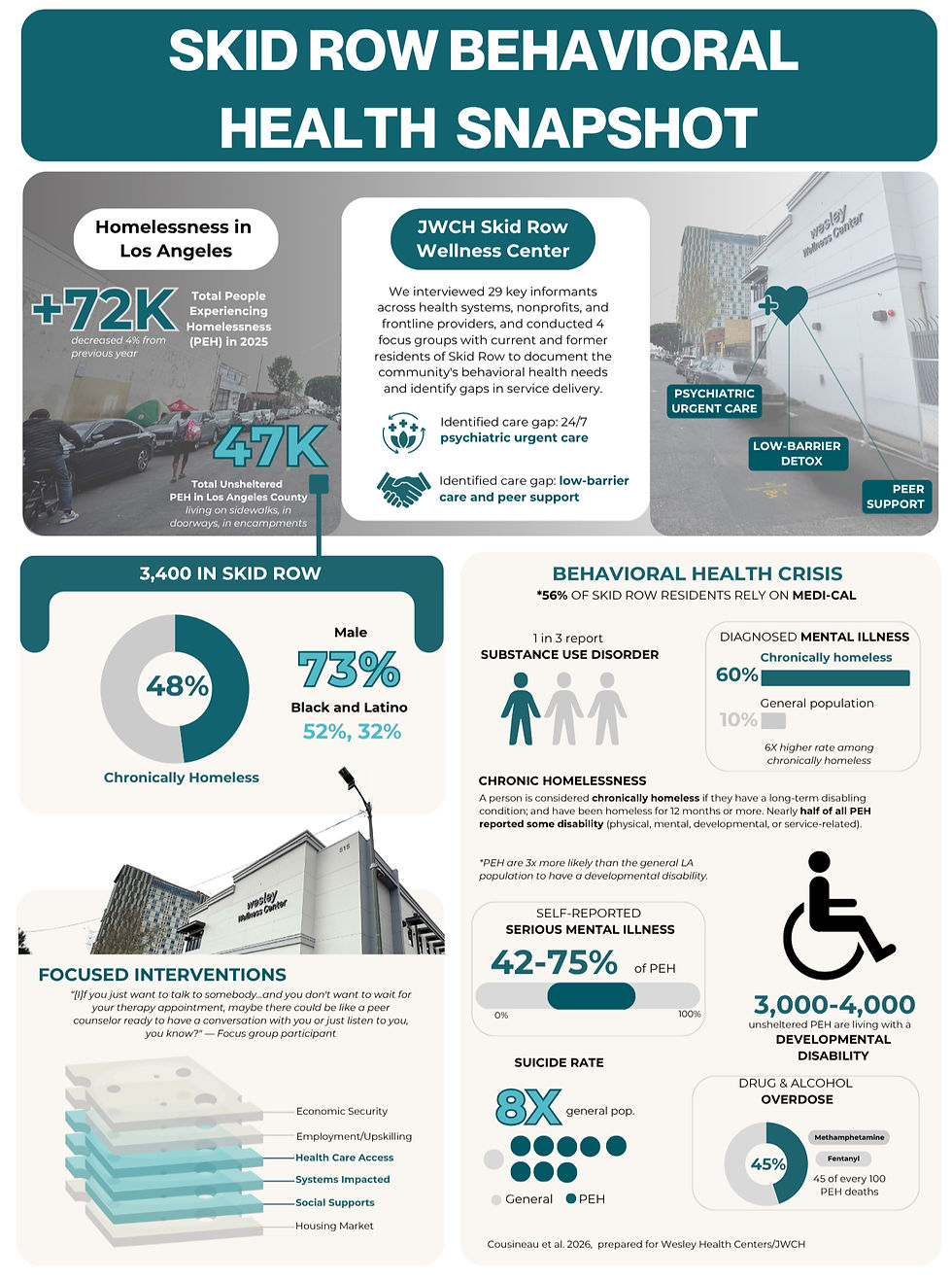
See the accompanying behavioral health snapshot from the project below:
Download the snapshot here:
Despite a recent 4% decrease in the overall count, there are more than 72,000 people experiencing homelessness (PEH) in LA County right now, with over 47,000 of them unsheltered. 3,400 of those unsheltered PEH are concentrated in Skid Row alone, nearly half of whom meet the definition of chronically homeless, meaning they have been without stable housing for over a year while living with a long-term disabling condition. And 3,000 to 4,000 unsheltered individuals countywide are living with a developmental disability, a population that remains largely invisible in existing service systems, particularly those who were never diagnosed before age 22.
Demographically, Skid Row residents are overwhelmingly male (73%), predominantly Black (52%) and Latino (32%), and 56% rely on Medi-Cal as their primary coverage.
Behavioral Health Service Use Is High
1 in 3 PEH report a substance use disorder. Between 42 and 75% self-report serious mental illness. Among the chronically homeless, 60% have a diagnosed mental illness, which is six times the rate of the general population. The suicide rate among PEH is 8 times higher than the general population. Drug and alcohol overdose accounts for 45 out of every 100 deaths. The dominant drugs on Skid Row are methamphetamine and fentanyl.
Tour of Wesley Health Center Care Campus
Closing Service Delivery Gaps Through Strategic Public Health Investments
To further document these needs and service delivery gaps, we interviewed 29 key informants across health systems, nonprofits, and frontline providers, and conducted 4 focus groups with current and former residents of Skid Row. What emerged were two consistent, urgent care gaps: the absence of 24/7 psychiatric urgent care and the lack of low-barrier care with integrated peer support available in the neighborhood.
As one focus group participant put it:
"[I]f you just want to talk to somebody...and you don't want to wait for your therapy appointment, maybe there could be like a peer counselor ready to have a conversation with you or just listen to you, you know?"
Wellness Center to Open Doors in 2026
The proposed JWCH Skid Row Wellness Center is designed to address these gaps with low-barrier detox, psychiatric urgent care, and peer support as core pillars, a model shaped by community input, with doors set to open later this summer.
Acknowledgements
Completing a project like this takes a village. Thank you to Dr. Michael Cousineau for leading this work, and to Rebecca Salazar Cousineau, Avery Uriostegui Muniz, Alexus Espino, Kylie Clark, James Cook, Hilda Sandoval, Kai Ya Tsai, and Byron Lindo for their contributions to the research, facilitation, and analysis that made this report possible.
Cousineau et al., 2026, prepared for Wesley Health Centers/JWCH by Sayrs Consulting


Comments